


A forklift turning out of an aisle, a pallet left across a walkway or a delivery arriving during shift change: warehouse risks often meet in the same busy space. This guide explains common warehouse hazards, why incidents happen and the practical measures that help reduce risk. You will also find clear, straightforward advice on where barriers, safety mirrors and floor marking make the biggest difference to day-to-day safety.
The most common warehouse accidents and why they happen
Warehouses are busy, pressured environments, and that combination alone creates risk. When you have forklift trucks, pedestrians, heavy racking and rolling deadlines all sharing the same space, the conditions for a warehouse accident are rarely far away.
The hazards tend to cluster around a handful of familiar areas. Vehicle movements are consistently one of the biggest concerns. Blind corners, poor sightlines and the absence of clearly defined pedestrian routes mean people and forklifts end up sharing space that was never designed for both at once. During peak periods that risk increases sharply: more vehicle movements, extra staff and less space for storage or manoeuvring. It is worth thinking carefully about how your traffic management holds up under pressure, not just on a quiet Tuesday.
Racking is another area that catches operations out. Overloaded shelves, damaged uprights that nobody has got round to reporting, and stock stored at awkward heights all contribute to falling object incidents and collapse. These are not rare events. HSE figures show that being struck by a moving object, which includes falling objects, caused 21 of the 126 worker deaths reported in Great Britain in 2025/26.
Slips and trips are deceptively common too. Spillages, trailing cables, uneven flooring and poorly lit walkways all create opportunities for people to come off badly, often in the spots that see the heaviest foot traffic throughout the shift.
Manual handling rounds out the picture. Heavy, awkward or repetitive lifting is one of the most consistent causes of common warehouse injuries, and it often goes unreported until the damage has quietly built up over time.
Some risks build gradually, such as damaged flooring or worn markings. Others arise immediately when a load shifts or a vehicle enters a pedestrian route. Knowing where to look is the first step to staying ahead of them.
Knowing what type of warehouse accident to watch for is useful. Knowing why it happens is what actually keeps people safe. Here are the incident types that crop up most often in UK warehouses, along with the root causes behind each one.
-
Slips, trips and falls — Wet floors, poor drainage, trailing cables and cluttered walkways are the usual culprits. These account for some of the most common warehouse injuries and are almost always preventable by addressing spillages, damaged flooring, trailing cables and obstructions. Markings help identify routes, but do not replace cleaning, repairs or keeping them clear.
-
Forklift and vehicle collisions — Shared spaces with no clear separation between pedestrians and moving vehicles are a serious warehouse safety hazard. Blind corners, poor sightlines and the absence of physical barriers all push the risk up sharply.
-
Falling objects — Overloaded racking, poorly stacked pallets and unsecured overhead loads create constant danger for anyone working below. It only takes one unstable load to cause a life-changing injury.
-
Falls from height — Picking, maintenance and access to vehicle beds need suitable equipment and planned working arrangements. Avoid improvised access, such as climbing racking or standing on pallets raised by a forklift.
-
Loading bay incidents — Reversing vehicles, unexpected trailer movement, premature drive-away and falls from loading edges all need to be considered. Easy to overlook; costly to ignore.
-
Manual handling injuries — First consider whether hazardous manual handling can be avoided. Where it cannot, assess the task and reduce risk through suitable handling aids, layout changes and training. Review routine tasks too: repeated lifting, twisting and reaching can create risks that are easy to overlook.
-
Struck-by accidents — Workers being hit by moving equipment, swinging loads or reversing vehicles. These tend to happen where vehicle routes and pedestrian paths have never been properly separated or defined.
Worth knowing: HSE figures show that being struck by a vehicle accounts for 16% of all fatal work related injuries in Great Britain, around 21 deaths a year over the past five years.
Understanding what sits behind each incident type is the foundation of any solid warehouse risk assessment. Once you know what creates the risk, you can put the right controls in place, whether that means physical segregation, loading bay & warehouse barriers or clearer pedestrian routes. Prevention always starts with clarity.
How to prevent warehouse accidents before they start
Preventing warehouse accidents starts with how the site is laid out and how work is organised. Separate people from vehicles wherever practicable, deal with hazards promptly and review controls when operations change.
-
Separate pedestrians from vehicles from the start. Keep pedestrian and vehicle routes separate wherever practicable with marked walkways. Where barriers are needed, choose protection suited to the risk and installation conditions, such as pedestrian guardrail barriers, impact protection barriers. Markings and signs help identify routes, while safety mirrors improve visibility at restricted sightlines.to keep people and moving vehicles apart. Choose controls through the site assessment, prioritising separation of pedestrians and vehicles wherever practicable.
-
Enforce storage discipline. Respect racking load limits, inspect racking regularly for damage, and never allow floor stacking in walkways or near exits. One overloaded shelf can bring down far more than people expect.
-
Train everyone, not just the regulars. New starters and agency workers are particularly vulnerable, often because nobody told them the rules. Make sure every person on site understands traffic routes, load handling procedures and what to do when something looks wrong.
-
Keep housekeeping daily, not weekly. Spills, loose packaging and stray pallets are trip hazards waiting to happen. A quick sweep at the start and end of each shift and respond to spillages and obstructions throughout the day.
-
Get the lighting right. Poor lighting in aisles, loading bays and dock areas contributes to more incidents than most people realise. If you can't clearly see what's coming, you can't react to it in time.
-
Run scheduled checks and warehouse risk assessments. A documented risk assessment isn't just a box-ticking exercise — it's a practical tool for spotting problems before they become injuries. Review it regularly, not just after something goes wrong.
Worth knowing: HSE’s warehousing guidance advises that where vehicles and pedestrians use the same traffic route, ideally there should be adequate separation between them. Physical separation between pedestrians and vehicles consistently ranks among the most impactful controls you can put in place.
Preventing a warehouse accident is rarely about one big intervention. It's about layering simple, consistent controls — from daily housekeeping to physical segregation — so that risk is managed at every level. These measures support safer operation, alongside the other duties and checks relevant to your workplace.
Where barriers, mirrors and floor marking make the biggest difference
The right physical controls, placed in the right spots, are one of the most effective forms of warehouse accident prevention available. Barriers, mirrors and floor marking are not generic safety tick-boxes — they are targeted solutions built around specific hazard points, and their value comes entirely from where and how you use them.
Barriers: choose protection for the job
A walkway beside a forklift route, an exposed racking upright and a loading-bay wall need different types of protection. Start with what you need the barrier to do: guide people, protect equipment from accidental contact or provide a specified level of vehicle-impact resistance.
|
Where protection is needed |
Products to consider |
What to check |
|
Pedestrian routes and crossing points |
Pedestrian guardrails and suitable pedestrian gates |
These can guide people towards designated routes. Do not assume a pedestrian rail is designed to withstand forklift impact. |
|
Walkways alongside vehicle routes |
Appropriately specified warehouse impact barriers |
Check documented impact performance, fixing requirements and any clearance needed behind the barrier. |
|
Individual racking uprights |
Racking upright protectors |
Match the protector to the upright and installation requirements. Protection does not replace racking inspections or repairs. |
|
Exposed ends of racking rows |
Racking end-frame protection barriers |
Check the dimensions, fixing positions and suitability for the expected vehicle contact. |
|
Machinery, columns and door surrounds |
Suitable protective bollards, hoop barriers or impact-protection systems |
Consider vehicle movements, the equipment being protected and the space needed for normal operation. |
|
Loading-dock walls and structures |
Loading-bay buffers and suitable protective barriers |
Buffers help protect structures from contact; they do not replace arrangements to prevent vehicle movement or falls from loading edges. |
The right specification depends on the vehicles, their speed and approach, the installation surface and the space available. Explore our loading-bay and warehouse barriers, or share your layout and vehicle details with our team to discuss suitable options.
Loading bays: manage the delivery, not just the doorway
A delivery brings together a visiting driver, warehouse staff, handling equipment and a vehicle that must remain secure during loading. Agree where the driver waits, keep uninvolved pedestrians clear and establish how everyone knows when loading is complete. Check vehicle and trailer stability, measures against premature drive-away, and protection at exposed edges.
Buffers and protective barriers can help protect the dock and surrounding structures, but they support the operating arrangements rather than replace them.
Mirrors
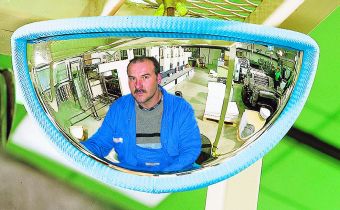
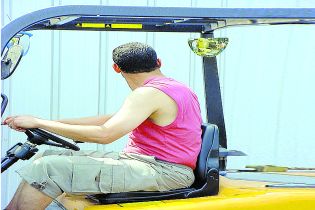
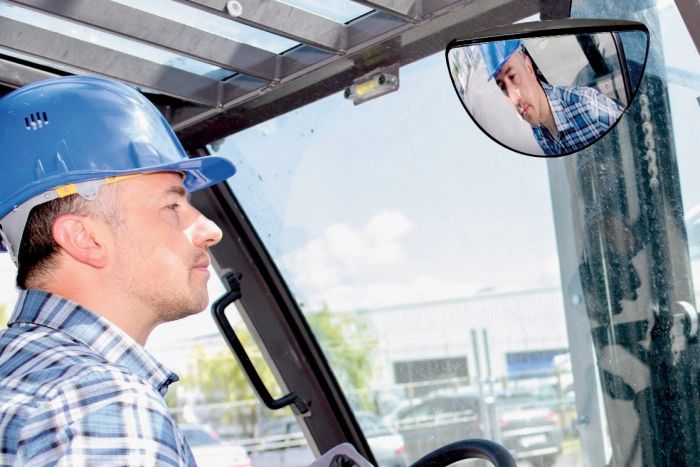
Convex safety mirrors can improve visibility at restricted sightlines, but they do not replace a suitable layout, pedestrian separation or controlled vehicle movement.
Position them:
-
At aisle junctions and internal corners where vehicles turn blind
-
At the ends of racking rows where forklifts emerge unexpectedly
-
Near pedestrian access doors that open onto busy vehicle routes
-
At the exits of goods-in and despatch areas
Floor marking
Floor markings make routes, crossings and exclusion zones easier to recognise. Use suitable signs and staff briefings alongside them where needed.
Use it for:
-
Dedicated pedestrian walkways running the full length of operational areas
-
Hatched exclusion zones around machinery, loading bays and racking
-
Directional arrows for one-way vehicle flow
-
Colour-coded zones distinguishing storage, picking and transit areas
Worth knowing: Workplace traffic routes must allow people and vehicles to move safely. Provide separate pedestrian routes wherever practicable, with suitable signs and markings where needed.Workplace traffic routes must allow safe movement, with suitable signs and markings where needed for health and safety.
Used together, these three measures create overlapping layers of protection that steadily reduce the conditions behind the most common warehouse injuries. If you want a structured way to identify where each one belongs on your site, a thorough warehouse risk assessment is the logical place to start.
What to do after a warehouse accident happens
After an incident, protect people, obtain help and prevent further harm. Follow your emergency arrangements, then record, report and investigate as appropriate.
Responding quickly and correctly after a warehouse accident is not just good practice — it is a legal requirement. Getting it right protects your people, keeps you on the right side of warehouse safety regulations, and gives you the best chance of making sure it never happens again.
-
Protect people and call for help. Follow the emergency plan, summon first aid and emergency services where needed, and prevent further exposure without putting others at risk.
-
Control the immediate hazards. Stop affected operations and isolate equipment where safe and appropriate.
-
Record and report. Notify the responsible manager and record the incident. The responsible person should check whether a RIDDOR report is required and the applicable deadline.
-
Investigate when safe. Preserve relevant evidence where practicable, without delaying rescue, treatment or essential hazard control.
-
Review and act. Identify immediate and underlying causes, update the assessment and controls, and brief affected staff before restarting work.
A post-incident review helps identify what went wrong and whether changes are needed to the layout, working procedures, training or physical protection.
A simple warehouse safety routine you can keep up all year
Good safety habits only work if they stick. And the busiest periods, think peak Christmas despatch or January sale surges, are precisely when corners get cut and warehouse accidents become more likely.
The good news? Staying on top of warehouse safety does not have to be complicated. Build these habits into your regular routine and they will quickly become second nature.
Walk the floor daily. Before each shift starts, check that barriers and floor markings are intact, walkways are clear and nothing new has crept in overnight. It only takes a few minutes and it catches problems early.
Review your risk assessment seasonally. Layouts change, stock levels shift and temporary staff arrive. Update your warehouse risk assessment whenever something significant changes, not just once a year.
Keep safety equipment in good condition. Faded floor tape, damaged barriers and missing signage are easy to overlook but they create real risk. Report damaged or ineffective equipment and assess whether it needs repair or replacement. Where protection may be compromised, control access until it has been checked.
Brief your team regularly. A short toolbox talk before a busy period is one of the simplest ways to prevent common warehouse injuries caused by rushing or poor communication. Never underestimate it.
Use the right kit for temporary hazards. Spills, maintenance work and congested zones all need fast, flexible solutions. Safety cones and cone toppers are a low-cost way to flag a problem area quickly, with no fuss.
Reviewing a walkway, racking end or loading area? Send Barriers Direct your layout, photographs, vehicle details and what needs protecting. Our team can help you compare suitable products and installation requirements.