





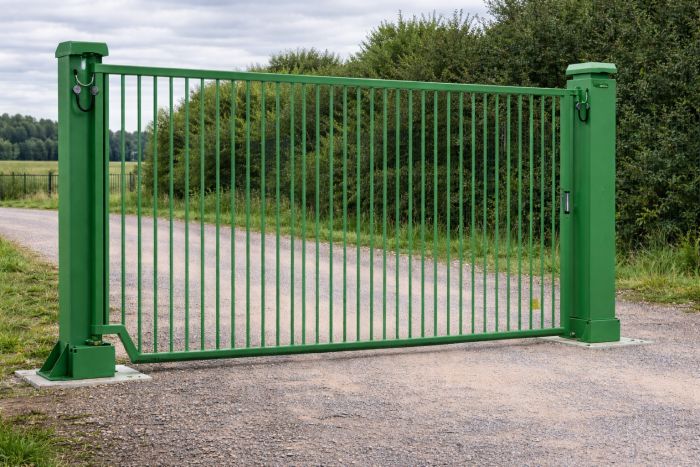
Choosing between a sliding gate and a swing gate is one of those decisions that looks straightforward until the ground is sloped, the space is tight, or the site starts seeing real daily traffic. This sliding gate design guide cuts through the noise to cover how cantilever gates work, what space and ground conditions you actually need, and which design details will make or break the installation. Planning these details early helps you choose a gate that fits your site and avoid costly changes later.
Sliding or swing gate: which one actually fits your entrance?
Swing and sliding gates need different kinds of space. Before choosing, check the clear opening, vehicle approach, pedestrian routes and the area available for the gate to move.
Swing gates need enough unobstructed space for each leaf to open fully without hitting vehicles, walls or rising ground. They can suit commercial as well as residential entrances, provided the ground levels, wind exposure, operating frequency and automation are properly considered.
Sliding gates move sideways, so they do not need the same opening space across the driveway. However, they need sufficient room beside the entrance for the gate to retract, together with appropriate clearances and protection around the moving leaf.
Neither format is automatically better for a busy site. Compare the complete system against your traffic levels, largest vehicles, available space and access-control requirements. A site survey can establish which arrangement is practical before you commit to a design.
If your main requirement is managing vehicle entry rather than closing the entrance with a full-height gate, automatic arm barriers may also be worth considering. Compare the access-control and security requirements before choosing.
How a cantilever sliding gate works, and why it solves tricky sites
A cantilever sliding gate is supported by roller carriages anchored to foundations beside the entrance. A supporting beam incorporated into the gate travels over these carriages, allowing the leaf to move without a ground rail across the driveway.
The gate includes a rear counterbalance section, so its overall length is greater than the clear opening. This arrangement keeps the driveway free of a running track, but requires sufficient side space and foundations designed for the system.
Cantilever gates are worth considering where:
-
Gravel, debris or heavy vehicle movements would make a driveway track undesirable.
-
The entrance surface is uneven, provided the gate can maintain suitable clearance throughout its travel.
-
A clear driveway surface is important for daily operations.
-
There is enough room beside the entrance for the full gate and its protected run-back area.
A cantilever design does not remove the need to assess gradients, drainage, wind exposure or ground conditions. The gate normally travels along a designed, level line; a sloping driveway still needs checking for clearance and potentially excessive gaps beneath the leaf.
Where side space is limited, a swing gate or another entrance arrangement may be more practical.
What space do you need? Opening width, run-back space and clearance
Most people measure the clear opening and stop there. That is only the starting point. A good sliding gate design needs three checks: the width you want to secure, the space the gate needs to travel, and any clearance issues around the entrance itself.
|
What to measure |
Cantilever sliding gate |
Swing gate |
|---|---|---|
|
Clear opening width |
The drive or entrance width you need to keep usable when the gate is open |
The same starting point |
|
Total gate length |
Greater than the clear opening because it includes a counterbalance section; confirm the manufacturer’s dimensions |
Leaf widths depend on the opening, configuration and installation clearances |
|
Side run-back space |
Sufficient unobstructed space for the gate to retract fully, including required safety clearances |
No sideways run-back space, but room is needed for the leaves to swing open |
|
Space needed to open |
No swing opening space required, but sufficient side space, safety clearances and a protected movement area are needed |
Enough unobstructed space for each leaf to open fully |
|
Underside clearance |
Check clearance across the opening and full run-back area, including changes in ground level |
Check clearance beneath each leaf throughout opening and closing |
The clear opening is not the overall gate length. A cantilever gate also needs a counterbalance tail, and the required run-back space depends on the specific design. Obtain the manufacturer’s layout drawing showing the opening, overall gate length, support positions, foundations and full movement area. Include any extra space needed for guarding, automation and maintenance access before confirming that the gate fits.
For swing gates, measure the space each leaf needs to open fully. A 4m entrance with two 2m leaves needs sufficient clearance for both leaves, without hitting parked cars, walls or rising ground, or obstructing the pavement.
Check the full movement area for walls, fencing, parked vehicles, vegetation, services and changes in level. Plan pedestrian access separately where practicable, and ensure the retracting gate cannot create accessible trapping points against nearby structures.
Ground conditions matter more than most people think
Removing the driveway track solves one installation challenge, but the ground still needs careful assessment. Cantilever gate loads are carried through the support system into foundations beside the entrance.
Before choosing the gate, check:
-
Ground levels: Survey the opening and full run-back area so the gate clears the surface throughout its travel.
-
Ground-bearing conditions: Foundations must suit the gate system and local ground. Soft ground, made ground or nearby excavations may require additional design input.
-
Underground services: Identify services before planning excavation, foundation positions and cable routes.
-
Drainage: Keep water away from vulnerable equipment and avoid drainage arrangements that undermine foundations or obstruct access.
-
Weather and debris: Allow for wind exposure, snow, ice and debris around the moving leaf and operating equipment.
A cantilever gate avoids a running rail across the driveway, reducing reliance on that surface for movement. It still needs correctly designed foundations, suitable clearances and ongoing inspection.
If you need help with groundwork and fitting, ask about our gate installation service before ordering, so the product and installation can be considered together.
Design details that make or break a sliding gate
Good sliding gate design considers appearance alongside the structure, operating equipment and daily use. Planning these details together helps avoid problems with movement, alignment and reliability.
-
Opening width and vehicle approach — allow for the largest vehicles, turning movements and usable clearance between posts.
-
Overall gate length and run-back space — use the manufacturer’s dimensions, including the counterbalance tail and protected movement area.
-
Foundations and supporting hardware — specify carriages, anchors, support posts and receiving posts as part of the gate system. General-purpose posts are not substitutes.
-
Gate weight, infill and wind exposure — assess the complete gate, including cladding or signage. Solid infill can materially affect wind loading.
-
Operating frequency — tell the supplier the expected daily movements and peak consecutive cycles so the gate and automation can be specified appropriately.
-
Automation and access controls — consider opening speed, vehicle detection and integration with existing systems. Discuss compatible intercoms, keypads and authorised-user controls alongside the gate specification.
-
Powered-gate safety — assess crushing, shearing, drawing-in and trapping hazards throughout opening and closing, including the run-back area. Specify suitable guarding and protective measures for the complete installation.
-
Power failure and emergency access — establish how authorised users release or operate the gate and how emergency access will be managed.
-
Inspection and servicing — include maintenance access, handover instructions and the manufacturer’s inspection and servicing requirements.
-
Vehicle-impact performance, where required — request documented test evidence and installation details for the exact system rather than assuming an access-control gate provides hostile-vehicle protection.
Before choosing a style, confirm there is enough room for the complete gate, counterbalance section and operating equipment. Check the full layout first, then compare suitable designs.
Crash-rated sliding gates and Martyn's Law
A standard access-control gate should not be assumed to provide tested protection against a hostile vehicle. Where the security assessment identifies a vehicle threat, obtain specialist advice on the entrance and surrounding perimeter.
For an impact-rated gate, check the exact model’s test evidence, including vehicle mass, impact speed, angle and penetration distance. Relevant evidence may reference ISO 22343-1, IWA 14-1 or PAS 68. The proposed foundations and installation must match the system’s documented requirements.
Martyn’s Law—the Terrorism (Protection of Premises) Act 2025—does not impose a blanket requirement to install crash-rated gates or bollards. Whether premises or events fall within scope depends on the statutory criteria, rather than simply being a busy workplace.
Standard-tier premises focus on public protection procedures. Enhanced-tier premises and qualifying events have additional requirements concerning appropriate, reasonably practicable protective measures. Product selection should follow the site’s assessed needs.
Where vehicle-impact protection is required, plan the complete boundary, vehicle entrance and pedestrian access together. A gate cannot address an unprotected approach elsewhere on the perimeter. If the assessment identifies a vehicle-impact threat beyond the gate opening, crash-rated bollards may form part of the wider perimeter design.
Which gate is best for your site, budget and day-to-day use?
Start with the entrance layout and operating requirements. A cantilever gate may be a strong option where a driveway track is undesirable and sufficient side space is available. A swing gate may be more practical where there is enough space for the leaves to open fully but limited room beside the entrance.
Compare complete installed costs, including foundations, electrical work, access controls, safety measures, commissioning and servicing. Avoid judging value from the gate price alone.
Browse our cantilever sliding gates, then send us the following details for help comparing suitable options:
-
The clear opening width and required gate height.
-
Photographs of the entrance and available space on both sides.
-
Ground levels, surface details and any known underground services.
-
The largest vehicles using the entrance and expected daily movements.
-
Manual or automatic operation requirements, including access controls.
-
Any specified security or vehicle-impact performance.
Our team can help you compare suitable gates and discuss installation requirements before you order.
Frequently Asked Questions
What is the best design for sliding gates?
The best design depends on the opening width, side space, ground conditions, operating frequency and security requirements. A cantilever gate avoids a ground track across the driveway, but needs a counterbalance tail, suitable foundations and a protected run-back area. Compare the manufacturer’s layout and installation requirements against your site before choosing.
What are the disadvantages of sliding gates?
The main drawbacks are space and planning. A sliding gate needs clear run-back space along the fence line, and a cantilever gate is longer than the opening because of its counterbalance section. Design also needs to be right from the start, especially around posts, automation, weight and full travel length.
What information do I need for a cantilever gate quotation?
Provide the opening width, required height, entrance photographs, available run-back space and expected vehicle movements. Include automation, access-control and installation requirements, plus any specified impact rating. Final dimensions and groundwork requirements should be confirmed through the appropriate survey and design process.


