





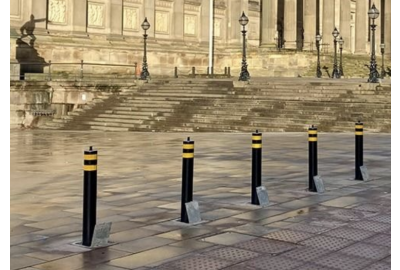
A safer entrance starts with understanding how your site works. Where do visitors queue? Which vehicles need access? What happens during an emergency? As organisations prepare for Martyn’s Law, these are useful questions to revisit. Bollards may form part of the answer—but access control, everyday deterrence and tested vehicle protection are different jobs. This guide explains the distinctions.
Why was Martyn’s Law introduced?
Martyn’s Law is named in memory of Martyn Hett, one of the 22 people killed in the Manchester Arena terrorist attack in May 2017. His mother, Figen Murray, campaigned for stronger requirements to help venues prepare for terrorist attacks and protect the people using them.
The Terrorism (Protection of Premises) Act 2025 received Royal Assent on 3 April 2025. It aims to make preparedness more consistent across qualifying premises and events—from knowing how to communicate and move people to safety, to considering appropriate protective measures at larger venues.
For organisations preparing for the legislation, the starting point is understanding their responsibilities and planning how to protect people. Bollards and other physical measures may support that work where appropriate, but purchasing equipment alone does not establish compliance.
If your site falls under Martyn’s Law, do you actually need crash rated bollards?
Martyn’s Law received Royal Assent in April 2025, but its duties have not yet commenced. Whether your premises or event falls within scope depends on its use, expected attendance and the Act’s qualifying criteria. The question we hear a lot is this: does complying with the Act actually mean you need crash rated bollards?
The honest answer is: not necessarily. It depends on your site.
The Terrorism (Protection of Premises) Act 2025 introduces different requirements for qualifying premises and events. Standard-tier premises generally expect 200–799 people at the same time; enhanced-tier premises generally expect 800 or more. Other qualifying criteria and exceptions apply, including special treatment for certain education premises and places of worship. Martyn’s Law does not automatically require venues to install bollards. Standard-tier duties focus on public protection procedures and do not require physical alterations or equipment purchases. Enhanced-tier duties include appropriate public protection measures, so far as reasonably practicable. The Act is deliberately non-prescriptive. It asks you to identify the threats relevant to your site and respond to them in a way that is proportionate.
A note on this guide: Official guidance on Martyn’s Law has been published, but there is no universal bollard specification for the Act, and your tier does not determine which type of bollard you need. This article is general product guidance explaining how bollard types differ. It is not advice on how to comply with the legislation. Any vehicle protection specification should follow an appropriate site assessment.
Preparedness comes first: how will staff communicate, move people to safety or secure the premises? Physical products should support the wider plan. A visible bollard or gate may help manage access, but appearance alone does not demonstrate protective performance.
That is where vehicle risk enters the conversation. If your venue has open frontage, a drop-off zone, a queuing area, or a pedestrian entrance that a vehicle could realistically reach at speed, then vehicle mitigation deserves a place in your security planning. The approach to an entrance matters as much as the entrance itself. Setbacks, vehicle routes and existing structures can influence the assessment, but should not be assumed to provide protection without checking their suitability.
The point is, there is no one-size-fits-all answer. Before you start pricing up crash impact bollards, start by identifying vehicle routes and exposed public areas. Where protection against hostile vehicles is needed, obtain a competent assessment to establish the performance required. The rest of this guide will help you work out what level of protection actually fits your situation.
Crash rated, anti ram or security bollards: what each one is designed to do
These terms get muddled all the time, but they are not the same thing. That matters, because choosing the wrong bollard can leave you under-protected or paying for more than you actually need.
Here is the simple breakdown:
|
Bollard description |
What it means |
What to check |
|
Crash-rated |
Documented performance under a defined vehicle-impact test, such as PAS 68 or IWA 14. |
Test standard, vehicle mass, speed, impact angle, penetration result and installation requirements. |
|
Anti-ram |
Describes an intended application; the term alone does not establish impact performance. |
Whether the exact model has supporting test evidence and what that evidence demonstrates. |
|
Security |
A broad description covering access restriction, deterrence and other security uses. |
The individual product’s intended purpose, construction, fixing method and any verified performance. |
The key difference is the evidence behind the product. Look for documented testing, including ISO 22343-1 or earlier PAS 68 and IWA 14-1 tests. A rating describes performance under specified conditions—not a guarantee against every vehicle impact.
That distinction makes Martyn’s Law decisions much easier. Start with the risk, then match the bollard to the real job on site.
Where crash rated bollards make sense: high-risk entrances and crowd-facing areas
Crash rated bollards make sense where the vehicle risk is higher and the consequences of getting it wrong are serious. In plain terms, that usually means places where vehicles can get close to busy public areas, and where a hostile or out-of-control vehicle could put a lot of people at risk very quickly.
Whether a site needs this level of protection depends on an assessment of its vehicle risk, not on whether it falls under Martyn’s Law or which tier applies. Settings where crash rated protection is commonly considered include: Not every site covered by Martyn’s Law will need this level of protection. But it should be on your shortlist if you manage:
-
Stadium approaches and sports venue perimeters where crowds build before and after events
-
Pedestrianised streets or town centres with access points that still allow occasional vehicles through
-
Open-air markets, public squares and civic spaces with regular heavy footfall
-
Event perimeters where vehicles and pedestrians need to be kept clearly apart
-
Busy transport forecourts such as bus stations, rail entrances and interchange points
-
Main public entrances to arenas, concert venues and major visitor attractions
In these settings, standard security bollards or lighter anti ram bollards may not be enough if the assessed vehicle threat is more severe. That is where crash rated bollards come into their own, because they have been impact tested to defined standards rather than simply described as “heavy duty”.
For permanent protection, compare fixed bollards with documented performance suited to the assessed requirement. Foundation space, underground services and pedestrian access also need to be considered. Where authorised vehicles need regular access, an automatic bollard may be worth considering. In each case, confirm the exact model’s test rating, foundation requirements and operating arrangements against the requirement set by your site assessment.The BFT XPASS 800 is a good example to investigate where tested impact performance and controlled access are both required. Confirm the exact model’s rating, foundation requirements and operating arrangements before specifying it.PAS 68 and IWA 14 cover impact testing in more detail and are worth checking if you need to compare ratings properly before you specify.
The key point is simple: use crash rated bollards where the risk, crowd density and exposure justify them. They can form an important part of a wider protective security plan, but they are not a box-ticking shortcut on their own. If your entrance is public-facing, vehicle-accessible and high consequence, this is usually the level of protection to assess first.
When access control and deterrence are the main requirements
Not every venue needs the cost and commitment of crash rated bollards to address a hostile vehicle threat. Some sites need to prevent unauthorised parking, restrict routine access or define a boundary. For these applications, a suitable security post may be appropriate. Where resistance to deliberate or accidental impact is required, check supporting performance evidence rather than relying on the description ‘anti-ram’. Useful questions include: Are you preventing unauthorised parking or protecting against impact? How frequently is access needed? Is staff operation practical? What foundations can the site accommodate? The answers help narrow the options without assuming that venue size or budget determines the protection required.
-
Retail shopfronts and high streets, where the realistic threat is ram raiding rather than a high-speed deliberate attack
-
Car parks and retail parks, where vehicle incidents are more likely to be accidental than intentional
-
Smaller event spaces and community venues, where an assessment has not identified a hostile vehicle riskwhere footfall sits below the higher-risk thresholds and the overall threat profile is lower
-
Sites that need regular vehicle access, such as delivery bays, service entrances or mixed-use forecourts
-
Premises with tighter budgets or limited groundwork options, where permanent installation simply is not practical
This is where removable and fold-down formats really come into their own, providing practical access control. They give you solid vehicle mitigation when you need it and straightforward access when you do not, with varying installation requirements. Removable models may need an excavated and concreted ground socket, and their impact performance must be checked separately. For an entrance needing a removable access-control post, our removable heavy-duty square security bollard is a practical starting point, built to deter opportunistic misuse and quick to deploy. Check its ground-socket requirements and handling arrangements. If impact resistance is part of the brief, request supporting evidence before selecting it.
, no-nonsense starting point for venues working through their vehicle mitigation options — built tough, quick to deploy and designed to help deter the kind of opportunistic threats most standard-tier sites are actually facing. Check its ground-socket requirements and handling arrangements. If impact resistance is part of the brief, request supporting evidence before selecting it.
Martyn’s Law guidance does not set a bollard specification, so choose products to meet a requirement identified for your site rather than to match a tier. Bear in mind that purchasing bollards does not, by itself, demonstrate compliance with Martyn’s Law.Martyn's Law calls for proportionate protection, not necessarily the highest-rated barriers available. Choose any additional products to address an identified site requirement. Bear in mind that purchasing bollards does not, by itself, demonstrate compliance with Martyn’s Law.
Do you need access control as well as protection?
Stopping power matters, but it is only half the picture. Before you settle on a bollard type, it is worth thinking about how your site actually operates on a normal day — because a fixed or removable bollard that works brilliantly as a deterrent can quickly become a headache if legitimate vehicles need regular access.
Ask yourself:
-
How often do authorised vehicles need to enter?
-
Will staff be on hand to manage access, or does it need to be automated?
-
Do you need the bollard to rise and lower quickly during busy periods?
-
Is this a permanent installation, or something that needs to be deployed and removed?
-
Who is responsible for operating and maintaining the system once it is in place?
Worth knowing: Standard security bollards are designed to deter opportunistic parking and low-speed incursions. They are not engineered to stop a determined vehicle attack. Where an assessment identifies a hostile vehicle threat, specify a vehicle security barrier system with appropriate performance evidence. An ‘anti-ram’ description alone is not enough.
Where access must remain available, compare appropriately rated automatic or removable systems. Consider opening frequency, emergency access, maintenance and the tested installation arrangement. Where vehicle access is occasional, a manually operated telescopic bollard may be worth considering. Our lift assist SP100 telescopic bollard is listed as tested to BSI PAS 68, stopping a 3,500kg vehicle at 48kph, and offers another operating format alongside automatic systems. Check the full rating, foundation requirements and handling arrangements against your site’s specification. Take a look at our full range of automatic bollards to find the right fit for your entrance.
Ultimately, whether you go for PAS 68 bollards, IWA 14-rated vehicle mitigation bollards, or a managed automatic system, the right choice will always come back to your specific risk profile and how your venue actually runs day to day.
Four questions to discuss before choosing bollards
What job must they do? Prevent unauthorised parking, manage access or provide protection against a defined vehicle threat?
What performance is required? Where impact protection matters, establish the requirement and ask for evidence for the exact product and installation.
How will access work? Consider deliveries, emergency vehicles, pedestrian movement and who will operate the system.
What can the site accommodate? Check foundations, underground services, drainage and space for installation and maintenance.
These answers provide a useful brief for comparing products and discussing installation. Your Martyn’s Law tier alone does not determine the bollard specification, and a short vehicle approach does not establish that an untested product is suitable.
Together with a site assessment where vehicle protection is needed, those four answers will narrow the options to the products that fit your site.Once you've worked through those four points, the right product usually becomes clear. Most sites don't need the heaviest-duty solution available — but some genuinely do, and getting that call right is what matters.
Planning an entrance upgrade? Share your site layout, access requirements and any specified impact-performance criteria with our team. We can help you compare products and installation options, and identify where further specialist assessment is needed. If you're at the budgeting stage, our bollard installation price guide is a useful place to begin.
How bollards fit into the wider security plan
A well-planned entrance needs to work for people as well as vehicles. Gates and entry systems can manage authorised access, while fencing helps define the perimeter. Clear pedestrian routes and staff procedures support everyday operation and emergency response. Where vehicle-impact protection is required, select bollards or barriers with suitable performance evidence. These measures do different jobs and should be planned together.
Frequently Asked Questions
What are crash-rated bollards?
Crash-rated bollards are bollards that have been independently tested to recognised standards such as PAS 68 or IWA 14. Their rating shows the vehicle weight and impact speed they have been proven to stop under controlled conditions, making them the benchmark where clear evidence of performance is needed.
Does ‘anti-ram’ mean crash-tested?
A safety bollard is typically used for access control, pedestrian separation and deterrence rather than stopping a determined vehicle attack. It helps manage nuisance parking and casual or accidental vehicle encroachment, but if there is a credible hostile vehicle risk, crash rated or anti ram bollards are the better fit.
Does Martyn’s Law require bollards?
No. Martyn’s Law does not automatically require venues to install bollards. Standard-tier duties focus on public protection procedures and do not require physical alterations or equipment purchases. Enhanced-tier premises and qualifying events must consider appropriate public protection measures, so far as reasonably practicable, but the Act does not prescribe a particular bollard. Where vehicle protection is needed, select products against the assessed requirement and supporting performance evidence. Buying bollards alone does not establish compliance.


