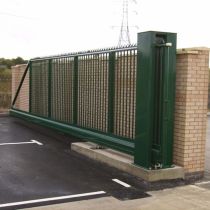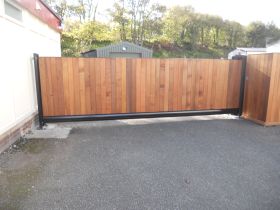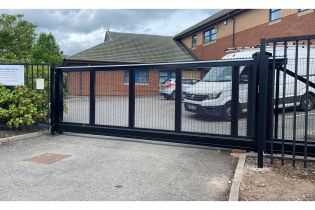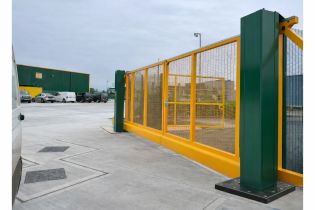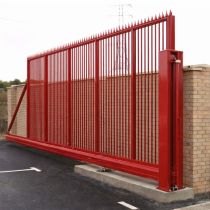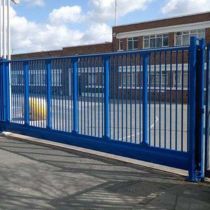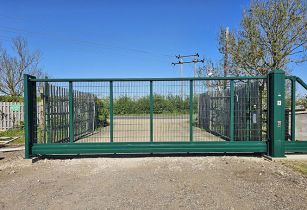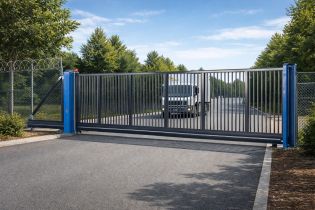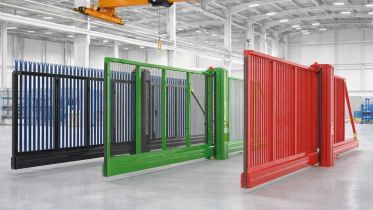



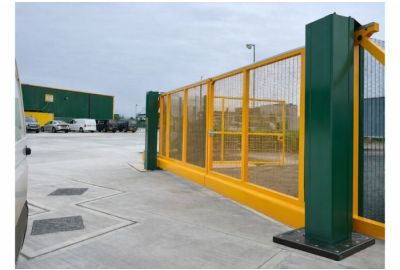
Cantilever sliding gates are one of the most practical ways to secure a commercial or industrial entrance. Unlike a tracked sliding gate, a cantilever gate is suspended off the ground and slides across the opening without a track running through it. So why does this matter? That single difference solves a lot of the problems that come with other gates: Cantilever gates do not require troublesome tracks and as such reduces maintenance or running issues.
This guide walks through everything worth understanding before you buy: how these gates work, how to size one for your site, the choice between manual and automatic, materials and finishes, the groundworks involved, automation and access control, and the UK safety rules that apply to any powered gate. It is written for the people who usually specify them, facilities managers, site managers, contractors and councils, but it is just as useful for anyone securing a larger private entrance.
How a cantilever sliding gate works
A cantilever gate carries its own weight from one side of the opening only. The gate leaf is longer than the gap it closes, and the extra length, known as the counterbalance, extends back past the gate posts. This is what balances the section spanning the opening, so the gate stays rigid and clear of the ground.
The gate runs on roller carriages (running gear), which are fitted inside the frame, this ensures that the rollers are protected from weather and grit. The rollers are made from heavy duty metal, but the rollers themselves are made from nylon. The nylon rollers ensure a smooth movement for the entirety of the gate so you can expect a smooth glide, rather than juddering.
There is also a small nylon roller added to the rear foundation on which the very rear of the gate sits on. This ensures a smooth run back of the gate. This can be concreted into a small foundation or in some instances, bolted down.
To ensure security, a catch post is fitted on its own concrete foundation. This is for the front edge of the gate to locate into when the gate is in the fully closed position.
As a rule of thumb, whatever the opening gap you require, you will need to allow for that same length + approx. a third. Ie a 6m gate will require a distance of 14m for it to run fully open and fully back. The leaf will be 6m, but will include the counterbalance section of approx. 2m. This run back and counterbalance section is also dependent on the height of the gate and the infill. The heavier the gate, the larger the counterbalance section is. Should the full space measurement not be accurate, this can result in the gate not fitting correctly. This should be measured accurately with a tape measure or other appropriate device, not paces.
Manual or automatic?
The first decision is whether you are wanting a manual gate or automatic.
Automating a manual gate is possible, however if you wish to upgrade at a later date, opting for a gate that is fully automated at the factory is the best decision. This will save you money and also ensures that all safety devices are fitted in a controlled environment, tested at the factory and are fully compliant from the outset.
A manual cantilever gate suits lower-frequency use or sites where power is not readily available or the budget is tighter. Someone has to be present to open and close it, however the manual gates supplied by Barriers Direct, run as smooth as a cantilever gate and you should be able to run the gate open and closed with a single finger, as they are perfectly balanced.
An automatic gate makes sense where the entrance is used more frequently, or those sites that wish for their users to have a nicer experience when accessing and leaving their site. You are able to select from a wide variety of access and exit controls, ensuring that you have the right solution for you and one that works for your site, when you are enabling entry and exit for a variety of staff, drivers and visitors.
Automatic gates however are required by law to comply with certain safety standards and regulations. The moment a gate is power-operated, the full UK powered-gate safety regime applies to it, including force limitation and an array of safety features. You can be rest assured that any powered gate from Barriers Direct complies with all current health and safety regulations and complies fully to UK requirements. A manual gate does not carry those same statutory obligations. None of this should put you off automating however - it simply needs specifying properly, which we cover further down.
Sizing your gate: the opening and the run-back
Measurements decide what you can have.
The first is the clear opening, the drive through gap that you require.
The second, and the one most often overlooked, is the run-back space. Whatever you have to cover the drive through gap, you must have the same plus a third for the gate to fully run open without impacting anything on the back.
The third is the height. Heights are available from 1.2m up to 3.0 metre options for commercial and secure sites. 1.8 or 2.4m are the most popular.
Height, width and infill is the main driver of wind loading: the taller the gate and wider, the more wind load it carries on its face, which depending on the infill, can turn the gate into a sail. This affects the frame, the posts, foundations and generally the stability of the structure of the gate and its fittings.
For very wide entrances there is a limit to how far a single leaf can span before mechanics and physics intervene. Beyond that point the answer is usually a bi-parting pair of gates. This is when two gates meet in the middle, each running back to its own side - bear in mind also that each side does not need to be equal to the other.
Bi-parting pairs of gates do not require catch posts but they have 2 points of closure. One at the top, usually called a “bird’s mouth” and one at the bottom, usually called a “ground shoe”. The bird’s mouth is part of the frame of the gate and one side hooks into the other. The ground shoe is a large metal device that is mounted to the floor and each leaf of the gate runs into its own shoe. This ensures the gates remain in place and do not part under pressure of a forced entry.
Materials and finishes
Most quality cantilever gates such as the ones Barriers Direct supply are built from aluminium, steel, or a combination of the two.
Aluminium is naturally corrosion-resistant, which makes it a strong choice for coastal, humid or industrial environments. It is also lighter, so it places less demand on the motor, which is why we can achieve longer and taller gates over steel framed gates. Most of our gates are made from aluminium, however we do have some that are mild steel.
Steel is heavier and stronger but does require galvanisation and/or specialised colour coating to prevent corrosion. As standard our steel gates come colour coated with a marine grade paint. We can offer a galvanised finish or galvanised and colour coated if required. This is only available on certain sizes due to the limitations on the lengths of steel that galvanising plants can offer.
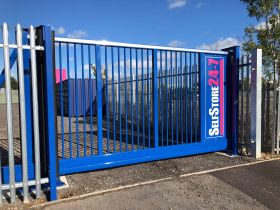
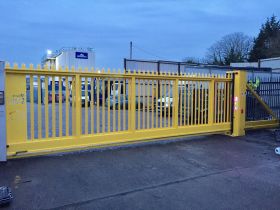
The infill is what fills the frame, and it affects both security and wind loading. Welded mesh, palisade and vertical bar infills are open, so they carry less wind load and can span further. Solid or semi-solid infills give more privacy and a different look but weigh more and catch more wind, which can limit the width available.
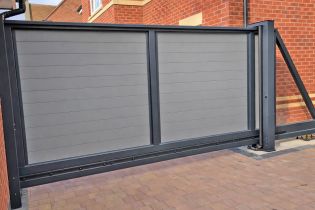
Barriers Direct have a huge choice of infill available, Welded mesh is available in V-Mesh, 358 (Prison mesh) or 868 which is widely used in school fencing. Vertical bars can be round, square or diamond. Composite infills are now very popular and we have a good range available as popularity is growing. We also offer louvre and solid sheet infills. Should you wish to add your own infill, we can supply gates with no infill. Simply send us a sample of the material that you have selected along with the infill details and we will check the width and height you can have to ensure your new gate will not be overloaded. We can even fit your own infill for you.
Site requirements and groundworks
Groundworks must comply with the drawings sent.
Firstly, each and every foundation needs to be level with each other and in a straight line. There is no tolerance in the gate’s safety and operating if this is not the case.
Secondly, the foundations must be poured to a minimum of C40 mix of concrete. It’s very important not to add scalpings, bricks or any other rubble as this will lower the quality of the concrete, and in turn the security of the gate.
Thirdly, the foundation sizes that we supply you must be poured accurately. If you need help, we can send an engineer to measure for you. This is a chargeable service but it is very important the foundations are to the perfect size, shape and mix.
We do not recommend fitting a gate within a flood plain or area that is prone to flooding. If you have an area prone to flooding, a manual gate may be your best option.
Automation and access control
An automated cantilever gate is more than just a motor. A compliant, well-specified installation brings together the operator, the safety devices and your chosen means of access and egress.
The operator is a sliding-gate motor and gear box, sized to the weight and duty of the leaf.
The safety devices are not optional extras. On a powered gate, safety devices are what makes it legal and safe. Photocells send an infra-red beam across the opening and stop or reverse the gate if something breaks the beam, and are usually fitted at more than one height. Safety edges are pressure-sensitive strips on the leading and on the closing edges of the leaf as well as front and back of the main tower. Our gates, as standard right out of the factory, have 6 safety edges fitted as standard. These edges stop and reverse the gate the instant they touch an obstruction.
Induction loops buried in the road surface detect vehicles but if fitted too close to a gate the metal in the gate can interfere with the loop so we recommend fitting a loop further away or using a radar or safety laser instead. Loops and radars are not legally required on gates as safety edges and photo cells are enough for keeping your gate compliant.
How people and vehicles trigger the gate is up to you. Loops, radars, keypads, intercoms/video intercoms, proximity fobs/cards, radio remotes, mobile phone operated GSM units and number-plate recognition (ANPR) are all common. The operator can integrate with a wider access-control or building-management system where you need audit trails and central control.
Safety and UK compliance
Any power-operated gate on a workplace or public-facing site is treated in law as machinery and sits within the Supply of Machinery (Safety) Regulations 2008 (previous the machinery directive), and there is a clear framework of standards and duties around it. This is not simply a paperwork exercise - powered gates can cause serious crushing and shearing injuries if they are wrongly specified or poorly maintained, so it is vital to understand what a compliant gate involves.
Three standards sit at the centre of this framework:
-
BS EN 13241 is the product standard. It covers the construction and performance of industrial, commercial and garage doors and gates, including aspects such as wind resistance, mechanical strength and durability.
-
BS EN 12453 is the operational safety standard. It specifies the safety requirements for power-operated gates, including measures to protect people against crushing, shearing, impact, drawing-in and other hazards, and sets limits on the operating forces where force limitation is used.
-
BS EN 12445 describes the test methods used to verify compliance with the force requirements in BS EN 12453. Measurements are taken using calibrated force-measuring equipment at specified locations on the gate.
Compliance also does not end at installation. Employers and duty holders must ensure powered gates are inspected, maintained and kept in safe working order throughout their service life.
In practice, the force a gate is allowed to exert is tightly limited. ALL of Barriers Direct’s gates are set to pass a force test before leaving the factory. These settings should not be adjusted. Changing the settings to make the gate roll faster will make the gate non-compliant. A power-operated gate placed on the market must carry the appropriate marking and documentation, and each installed gate should have its own risk assessment, because each and every site is different.
There is also an ongoing duty. Whoever owns, occupies or manages the site is responsible for keeping the gate safe in use, which means maintaining it and keeping its safety system working and tested. The recognised UK industry code of practice for the design, installation, force-testing and maintenance of powered gates is published by the DHF (Door and Hardware Federation), and it is the benchmark a good installer works to.
Every automated gate we supply is specified to meet these requirements. Requirements can and do change. If you are replacing or inheriting an existing powered gate, we recommend having its safety and force limitation checked, as older installations are not always compliant.
Our automated gates can be connected to fire alarms and set to open in the event of a fire alarm sounding.
Security ratings for higher-risk sites
For most commercial sites, a well-built cantilever gate with a strong infill and good locking is enough. Higher-risk sites sometimes need a certified level of protection, and it helps to know that two very different things are being measured:
-
Forced-entry resistance is rated under LPS 1175, which grades how long a gate resists a determined attack with tools. Testing is very expensive and whilst most of our gates do not carry a tested SR Rating, our Tytan range is our latest range available as SR1, SR2 or SR3, however we do have more coming to the market soon.
-
Vehicle-impact resistance, also known as hostile vehicle mitigation (HVM), is assessed under PAS 68 and IWA 14. These standards test a gate's ability to stop a vehicle driven at it at speed and are important where ram-raid or vehicle-as-a-weapon attacks are a credible risk. Martyn’s Law, by contrast, introduces counter-terrorism preparedness duties for certain public venues and events rather than setting vehicle-impact performance ratings. They protect against different things, so if you have a specific security requirement it is worth telling us which, and we will specify accordingly.
Buying as a complete system
Our Cantilever gates are supplied as a complete system rather than a single part. A gate system comprises the gate leaf, with the frame and your chosen infill, the running gear of roller carriages, guide rollers and end stop, and the catch and gate posts. On an automated gate, the motor, control system and the safety devices needed for compliance are specified alongside it, together with whatever access control you want.
Because every entrance is different, we work with you to understand your exact needs and will scope the specification required with you rather than sell an off-the-shelf box. Furthermore, we confirm precisely what is included so there are no surprises on site.
Maintenance and servicing
One of the quiet advantages of a cantilever gate is how little it asks of you. With no ground track to clog or damage, maintenance is lighter than a tracked gate, and a well-installed gate requires a service every 6 months, with a few simple owner checks in between, particularly before and after winter.
Servicing covers lubricating and checking the rollers, bearings and drive, checking alignment and the catch-post engagement, and inspecting the finish. On an automated gate it also means checking and force-testing the safety system, the photocells, safety edges and force limitation. On busier sites the safety system should be checked more often, and the right interval is the one that matches how hard the gate is worked. You must keep a record of maintenance for each visit and maintenance conducted.
Choosing the right gate for your site
Pulling it together, the specification usually falls out of a handful of questions:
-
Tell us about your site, commercial premises etc.
-
Why do you need a gate? What are you wanting it for/to stop?
-
Who needs to gain access to your site and what access control do the people and vehicles using it need?
-
How wide is the opening, and is there room for the gate to run back fully?
-
How often will it be used, and does that point to manual or automatic?
-
How secure does it need to be, and is that about forced entry, vehicle impact, or simply a solid commercial gate?
If you can answer those, we can specify the right gate. If you are not sure, that is exactly what a site survey is for. With a site survey, you will receive a full report from the engineers along with a quote from us that fits the requirements you require.
Frequently asked questions
How much space do I need for the gate to slide back?
Twice the length of the opening width plus approx a third more (this differs depending on the height) - a six metre opening needs around eight metres of clear run-back, or 14metres in total. These are approximates, so always check with the team before committing.
Why is a cantilever gate longer than my opening?
The extra length is the counterbalance, or tail, that extends back past the posts and balances the section spanning the opening. It is what lets the gate stay rigid and clear of the ground without a track or a supporting wheel at the leading edge.
Do cantilever gates work on sloping or uneven ground?
In theory it may be possible, provided your foundations are level and in line with each other. This is something that would need discussion and a better understanding of your site in order for us to make a recommendation.
Do cantilever gates work on ground the slopes up or down in to site?
Possibly providing the site is level and even from one end of the gate to the other. In fact, this is where cantilever gates can offer an excellent choice over a swinging gate as swing gates would not be able to open if the site was raised on the inside.
Do I need a track across the driveway?
No. A cantilever gate has no ground track across the opening, which is what makes it low-maintenance and suited to uneven ground (provided the foundations are level).
What is the widest single gate I can have?
12 metres
What is the widest opening I can have in total?
24 metres. This will be a bi-parting pair where two gates meet in the middle.
Manual or automatic, which type of gate do I need?
Automatic suits frequent use whilst Manual suits lower-use entrances or sites without power.
What groundworks are needed?
Level foundations that are all in line with the site specific drawings issued to you after purchase. All concrete would needs to be at least C40 mix. Anything less will void your warranty and increase the chances of the gate falling.
What electrics are required?
230 Volt, Single Phase, 10 Amp.
Is it compliant with UK safety law?
Every automated gate we supply is specified to meet the UK standards for powered gates, including BS EN 12453 for safety in use and its force limits. Each installed gate should also have its own risk assessment and ongoing maintenance.
How often does it need servicing?
Typically every 6 months but more often for a busy site, plus simple owner checks in between. An automated gate's safety system also needs checking and force-testing, with records kept.
Can I add a keypad, intercom or number-plate recognition?
Yes. Keypads, intercoms and video intercoms, fobs, remotes, GSM and number-plate recognition can all be fitted, and the gate can integrate with a wider access-control system.
Can I retrofit any access controls if I change my mind later?
Yes, providing your new access or exit controls can be connected to the control panel with a volt free signal
How does my gate get delivered?
Your gate will be delivered on an articulated hi-ab vehicle. The gates are lifted into place and you have 2-3 hours to ensure the gate is bolted in place and safe before the driver removes the gates harness.
Why does it need to be delivered on a hi-ab?
Gates are very large items, and require transport via the safest way possible. Our gates are delivered largely as a single piece, with the catch post and box of bolts and fittings. This means that assembly time on site is minimised and the driver can pull off usually within an hour of unloading.
How quickly can I have my gate delivered?
Lead times change on gates. Most of the time, we offer a 6 week lead time, this can sometimes be extended depending on how busy the factory is with orders. Sometimes lead times lengthen in summer as we have fabrication team members on holiday or November as many sites want their new gates before the Christmas shut down. If you need a gate quicker, call us and ask us as we may be able to fit your gate in sooner.
Can I have a different colour to what is listed on the website?
If you would like a different colour that is still a 4 digit RAL, the quick answer is yes we can do that - sometimes there will be no additional cost for this. If it is a paint we need to get in specially and it’s not a common 4 digit RAL, there may be a surcharge.
Can I have my company logo on my gate?
On certain gates we can offer a laser cutting service into the main tower. We can even offer backlighting on the logo which makes your brand really stand out at night.
Speak to our team experts
We supply cantilever sliding gates for commercial, industrial and secure sites across the UK, specified to your entrance rather than sold off the shelf, with trade pricing on larger and multi-site projects.
Talk to us about your requirements, we would be more than happy to help:
01279 597778